Code Upgrades, Matching and Ordinance & Law Coverage on a Roof Claim
 By Chris Grimes, owner of Verde RoofingPublished July 28, 2026 · 8 min read
In short
Code upgrades are items current building code requires that your old roof lacked, such as drip edge or a full tear-off when there are two layers. Whether insurance pays depends largely on your policy's ordinance or law coverage and its limit. Matching is separate: the Texas Department of Insurance warns an insurer might not replace a whole roof just because new shingles do not match perfectly. Read your policy before the storm.
Key takeaways
- Code upgrades are items your city's adopted code requires today that the old roof did not have, such as drip edge at eaves and rakes under the 2021 IRC.
- Ordinance or law coverage pays the extra cost of meeting code after a covered loss, up to a limit that is often a percentage of your dwelling coverage.
- In 2001 TDI required an endorsement adding $5,000 of building-law coverage to Texas HO-A, HO-B and HO-C forms, with optional higher limits; check what your own policy says today.
- TDI's consumer guidance says an insurer might not replace the entire roof even if new shingles do not match the old ones perfectly.
- List code items as separate estimate lines with the code section, and document matching problems with the shingle's identity and availability.
Your roof claim is approved, but the estimate leaves out the drip edge your roofer says the city requires, and it pays to fix one slope even though the new shingles will not match the rest. Two questions follow: who pays for what the code requires now, and who pays when the repair will look like a patch?
These are two of the most confusing parts of a roof claim in North Texas, and the answers live in your policy more than in any law. This guide explains what code upgrades and matching mean, how ordinance or law coverage works, what the Texas Department of Insurance says, and how to document both so your insurer can make a decision on real evidence.
What counts as a code upgrade on a roof?
A code upgrade is anything the current building code requires on a new roof that your old roof did not have. Cities across Dallas–Fort Worth adopt editions of the International Residential Code, often with local amendments, and a reroof usually needs a permit and has to meet the code in force when the work is done, not when the house was built.
Common examples on residential roofs:
- Drip edge. The 2021 IRC, section R905.2.8.5, requires drip edge at eaves and rakes on asphalt shingle roofs, overlapped at least 2 inches and fastened no more than 12 inches apart. Many older DFW roofs were built without it.
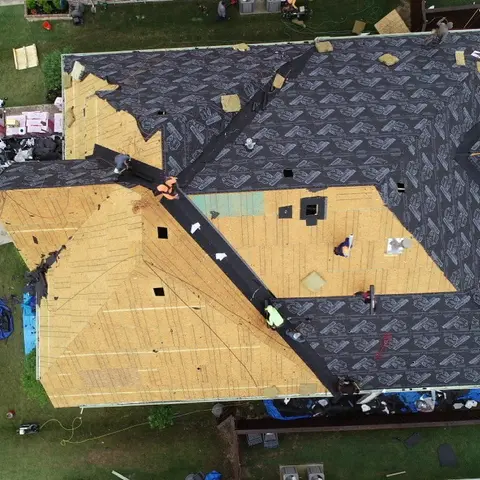
- Full tear-off of multiple layers. Under the 2021 IRC's reroofing rules, a new covering may not go over a roof that already has two or more layers, or over a deck that is water-soaked or deteriorated.
- Decking repairs. Damaged or deteriorated sheathing has to be fixed before it is covered again.
- Underlayment and flashing details required by the code your city adopted and by the shingle manufacturer's installation instructions.
The table shows how these typically come up on a claim.
| Item | Why it is required | Coverage that usually comes into play | What documents it |
|---|---|---|---|
| Drip edge at eaves and rakes | 2021 IRC R905.2.8.5 and manufacturer instructions | Ordinance or law coverage, or the main dwelling coverage, depending on the insurer | Photos of bare edges, the code section your city adopted |
| Tear-off of a second layer | IRC reroofing rules bar covering two or more layers | Usually part of the replacement scope once documented | Tear-off photos showing both layers |
| Deteriorated decking | Deck must be sound before reroofing | Covered if storm-damaged; age-related rot may not be | Photos of each sheet, with cause noted |
| Upgraded underlayment or flashing | Adopted code and manufacturer instructions | Ordinance or law coverage, or main coverage | Code reference and product instructions |
How a given insurer classifies each item varies, which is why the estimate should list code items as separate lines with the code section next to them. Our guide on underlayment, ventilation and decking explains what these parts do.
Does homeowners insurance pay for code upgrades?
It depends mostly on ordinance or law coverage, sometimes called building ordinance or increased cost of construction coverage. It pays the extra cost of bringing a damaged part of the home up to current code after a covered loss, up to a set limit.
Texas has a specific history here. In 2001, the Texas Department of Insurance adopted a mandatory endorsement for the Texas HO-A, HO-B and HO-C homeowners forms that provided $5,000 of coverage for increased construction costs caused by building laws, at no extra premium, with optional higher limits of 10%, 15% or 25% of the dwelling limit for an added premium. Many insurers now write their own policy forms, so do not assume those amounts are what you have. Check your policy.
Nationally, Policygenius reports that ordinance or law coverage is generally included up to about 10% of the dwelling coverage limit, with higher limits such as 25% or 50% available by endorsement. On a $350,000 dwelling limit, 10% would be about $35,000. A roof's code items rarely approach that, but on an older home where several systems are affected, limits can matter.
Two practical points:
- Coverage applies after a covered loss. It does not pay to bring an undamaged roof up to code just because it is old.
- The limit is a ceiling, not a promise. The insurer still decides which items are code-required and covered.
Will insurance pay to match the rest of the roof?
Matching is a separate question from code. The issue is that new shingles may not match the color or profile of the remaining roof, especially when the old product has faded in North Texas sun or is no longer made.
The Texas Department of Insurance's consumer guidance is direct: your company might not pay to replace the entire roof, even if the new shingles do not match the old ones perfectly. A mismatch alone does not automatically mean a full replacement. What your policy says about loss settlement, and how much of the roof is actually damaged, drive the outcome.
That does not mean matching never matters. When a shingle is discontinued, when available products differ in size or exposure so they cannot be woven into the old roof, or when damage is spread across most slopes, those facts belong in the documentation. The insurer decides; your job, and your roofer's, is to make sure it decides with the facts in front of it.
When I am asked whether a repair will match, I pull a shingle from a hidden spot, identify the brand and line, and check whether it is still made. That one step answers half the matching question before anyone argues about it.
How do you document code items and matching problems?
- Get the permit facts. Ask your roofer which code edition your city enforces and whether a permit is required for the work.
- List code items separately on the estimate, each with the code section and a photo of the existing condition.
- Photograph tear-off conditions the moment they are exposed: extra layers, decking, missing drip edge.
- Identify the existing shingle by brand, product line and color, with a photo of a sample and any markings.
- Get availability in writing. If it is discontinued, a supplier or manufacturer letter is stronger than a verbal claim.
- Show the mismatch with side-by-side photos of the closest available product next to the existing roof.
- Send it on the existing claim. If the items surface after the first estimate, they go in as a documented supplement. Our guide on roof insurance supplements explains how that works.
The Texas Department of Insurance tells homeowners that if a contractor finds damage or differences the adjuster missed, they should talk to their insurance company about them. Clear documentation makes that conversation short.
What a roofer can and cannot do here
Texas law bars a contractor from acting as a public adjuster on a property where it does, or may do, the work. A roofer does not settle or argue coverage for you. Verde Roofing's role is the contractor's role: Chris inspects with you, documents damage with photos, meets the adjuster on site, writes the estimate and any supplement request with code references and photos, explains the process and does the work. You own the claim. If you disagree with the insurer's coverage decision, a licensed public adjuster or attorney can represent you. See our insurance claim help page for how we work, and the adjuster's roof inspection guide for what happens on site.
Questions to ask your agent before hail season
- Do I have ordinance or law coverage, and what is the limit in dollars?
- What would it cost to raise it to 25%?
- Does my policy say anything about matching undamaged parts of the roof?
- Does my policy exclude cosmetic damage to roofing?
- Is my roof covered at replacement cost or actual cash value? Our guide to ACV vs. RCV and depreciation explains the difference.
Owners of older homes in Lakewood, Preston Hollow or the Park Cities should ask these questions first. A house built decades ago may need more to meet today's code than a newer home in a Frisco or McKinney subdivision.
Mistakes that cost homeowners money on code and matching
- Assuming the adjuster's first estimate includes code items. It often does not, because the adjuster cannot see what is under the shingles or what your city requires.
- Letting a roofer skip code items to fit the insurance number. A roof that fails inspection, or that does not follow the manufacturer's instructions, can create problems with the permit and the product warranty later.
- Throwing away the evidence. Old shingles, decking and a sample of the existing product should stay on site until the adjuster has seen them or confirmed photos are enough.
- Treating a mismatch as an automatic full replacement. It is not, under TDI's guidance. Build the case with facts instead of expectations.
- Paying for upgrades you chose without a change order. If you pick a better shingle or extra features the insurer will not cover, get the added cost in writing before work starts, so it is clear what is yours to pay.
Code items and matching also affect your estimate
When you compare roofing bids or an adjuster's estimate, look for drip edge, starter, underlayment, flashing and tear-off layers as separate lines. Our guide on how to read a roofing estimate shows what to look for, and our roof replacement page explains what a full replacement includes. If you are choosing between brands, our comparison of Malarkey and Owens Corning shingles covers how to compare lines and colors.
Get the code and matching questions answered first
Before you accept a scope that leaves out code items or patches a roof that will not match, find out what is really on your roof. Chris will inspect it with you, identify the shingle, note any code items your city requires and explain what the estimate covers. Call or text (214) 687-1951, 24/7, or book a free roof inspection.
Questions people ask next
Is drip edge a code upgrade or just part of the roof?
Under the 2021 International Residential Code, drip edge is required at eaves and rakes on asphalt shingle roofs, and shingle manufacturers' instructions often call for it too. If your old roof had none, adding it is usually treated as a code item. How your insurer classifies it varies, so it should appear as its own estimate line with the code reference.
How do I find out if I have ordinance or law coverage?
Look at your declarations page and endorsements for “ordinance or law,” “building ordinance” or “increased cost of construction.” Note the limit, whether it is a dollar amount or a percentage of dwelling coverage. If you cannot find it, ask your agent in writing whether you have it and what it costs to raise the limit.
What happens if my shingles are discontinued?
Document it. Identify the shingle by brand, line and color, and get written proof from a supplier or the manufacturer that it is no longer made. Show the insurer why available products are not a reasonable match. Whether that leads to a larger replacement depends on your policy and the insurer's decision, but you cannot make the case without the paperwork.
Does insurance pay for a full tear-off if my roof has two layers?
Removing an extra layer costs more, and the 2021 IRC does not allow a new roof covering over two or more existing layers. If the roof is being replaced after a covered loss, ask the adjuster whether removing the extra layer is included in the scope. Tear-off photos showing both layers are the evidence your roofer should supply.
Can I add ordinance or law coverage after a storm?
Coverage added after a loss will not apply to damage that already happened. That is why the time to review it is before hail season. If you own an older home or one with an older roof, ask your agent what limit makes sense, since code changes since the house was built can add up.
Sources
- Texas Department of Insurance: What to know about replacing your roof with insurance
- Texas Department of Insurance Bulletin B-0006-01: Building laws endorsements
- Policygenius: What is ordinance or law coverage?
- 2021 IRC R905.2.8.5: Drip edge requirements (summary)
- 2021 IRC R908.3: Reroofing and recover limits (summary)
- Texas Department of Insurance: Getting your insurance claim paid
Chris Grimes owns Verde Roofing in Plano, Texas, a locally owned residential and commercial roofer serving Dallas–Fort Worth. Verde is an NTRCA Accredited Member, an RCAT member and a Dallas Observer Best of Dallas Best Roofer winner (readers’ choice) in 2021, 2022 and 2023.
Keep reading
Related guides
 Insurance claimsWhat Is a Roof Insurance Supplement and When Is It Needed?A roof insurance supplement is a documented request, made on your existing claim, asking the insurer to add work or materials its first estimate left out…Read the guide Insurance claimsACV vs. RCV: Roof Depreciation and the Second Insurance CheckWith replacement cost (RCV) coverage, the insurer usually pays your roof claim in two checks: first the actual cash value, which is replacement cost minus depreciation…Read the guide
 Roofing materialsUnderlayment, Ventilation and Decking: The Parts of a Roof You Don't SeeUnder the shingles sit the decking (plywood or OSB), underlayment (synthetic or felt), self-adhered ice and water barrier at valleys and other leak-prone spots, drip edge…Read the guide