

Signs of Hail Damage on a Roof (and What Is Not Hail Damage)
 By Chris Grimes, owner of Verde RoofingPublished November 11, 2026 · 8 min read

In short
Real hail damage on a shingle roof shows up as random, roughly round impact marks where granules are knocked away and the mat underneath feels soft, like a bruise, or is cracked. It usually comes with dents in soft metal such as vents, gutters and downspouts. Blisters, edge wear, scuffs and missing granules in neat lines are usually age or installation, not hail.
Key takeaways
- Start on the ground: dents in gutters, downspouts, A/C fins and window wraps tell you whether hail big enough to matter hit your house.
- Hail hits in a random pattern; marks in straight lines or only on one shingle edge are usually wear, blisters or installation damage.
- A hail bruise can usually be felt as a soft spot in the shingle, and ridge caps are among the most vulnerable spots, according to IBHS.
- The National Weather Service calls hail of 1 inch or larger severe, and that is the size Triple-I uses to count major hail events.
- A free inspection with photos before you file tells you whether there is damage worth a claim at all.
A storm rolled through Plano or Frisco last night, the yard is covered in leaves and ice, and now a neighbor says a roofer is already knocking on doors down the street. You want to know one thing: did hail actually damage your roof, or not?
That question has a real answer, and you can get most of the way there from the ground. This guide shows what genuine hail damage looks like, the look-alikes that fool homeowners (and sometimes inspectors), and when it makes sense to have someone walk the roof.
How big does hail have to be before you should worry?
Size matters, but it is not the whole story. The National Weather Service defines a severe thunderstorm as one that produces hail at least 1 inch across, about the size of a U.S. quarter, or winds of 58 mph or more. The Insurance Information Institute (Triple-I) uses the same 1-inch line to count "major" hail events, and it recorded 902 of them in Texas in 2025, far more than any other state.
Smaller hail can still matter. A 15-year-old roof that has baked through North Texas summers is more brittle than a new one, and wind-driven hail hits harder than hail falling straight down. On the other side, a newer impact-resistant shingle can shrug off stones that would bruise a basic shingle.
| Hail size (common comparison) | Diameter | What it usually means for a shingle roof |
|---|---|---|
| Pea to nickel | under 1 inch | Rarely damages sound shingles; check soft metal anyway |
| Quarter | 1 inch | NWS severe threshold; older or worn shingles can bruise |
| Ping pong to golf ball | 1.5 to 1.75 inches | Damage to standard shingles is common; inspect closely |
| Tennis ball and larger | 2.5 inches and up | Expect damage to most roof types, plus siding and windows |
The sizes follow the National Weather Service hail size chart. Use the right-hand column as a sense of scale, not a verdict. The only way to know is to look at the roof itself.
What should you check from the ground first?
IBHS, the insurance industry's research lab, tells homeowners to start with collateral damage: dents and spatter on things around the house. If hail was big enough to dent metal, it was big enough to deserve a closer look at the roof.
Walk the house with your phone and check:
- Gutters and downspouts: round dents, especially on the top edge of the gutter
- Roof vents, turbines and pipe jacks you can see from the yard
- A/C condenser fins: IBHS lists dented fins as a classic sign
- Window screens, window wraps and metal trim
- Painted wood fences, mailboxes and the deck rail
- Vehicles that were parked outside
- Spatter marks: clean round spots where hail knocked oxidation or dirt off metal
IBHS notes that spatter is not damage in itself, but it proves hail hit and roughly how big it was. Photograph each item with something for scale, such as a coin or a tape measure. Those photos become part of your record, which we cover in how to document roof storm damage.
When I walk a roof after hail, the first thing I check is the soft metal: vents, gutters, window wraps. If the metal is clean, I look hard before I call anything on the shingles hail damage.
What does real hail damage look like on asphalt shingles?
On the roof, true hail hits share a few traits:
- Random pattern. IBHS puts it plainly: real hail damage occurs in a random pattern. Hits are scattered across a slope, not lined up along a course of shingles or a nail line.
- Roughly round marks. Granules are knocked away in a circle or oval, exposing the black asphalt or the mat underneath.
- A bruise you can feel. Press the center of a mark with a thumb. IBHS notes that a bruise can usually be felt on real hail impacts: the spot feels soft or spongy compared with the shingle around it.
- Fractures in the mat. On harder hits, the shingle cracks, sometimes in a star pattern, and the crack may show on the back.
- More hits on the slopes facing the storm. Hail usually arrives with wind, so the west or north slopes often take more than the others.
- Ridge caps hit hard. IBHS calls ridge caps one of the most hail-vulnerable parts of a shingle roof, because the shingle is bent over the ridge and exposed on top.
Damage that breaks the mat or knocks granules off down to the asphalt matters because granules are what shield the asphalt from the sun. Under a North Texas summer, a bruise left alone can turn into a crack, and a crack into a leak.
What about other roof types?
Metal roofs dent; the question is whether the dents are cosmetic or let water in, which we explain in hail dents on a metal roof. Concrete and clay tile crack or chip at the corners. Wood shakes split along the grain with sharp, fresh edges. Flat commercial membranes can be punctured or bruised, and are best checked with a core sample.
What is not hail damage?
This is where most bad calls happen. IBHS calls these "look-alikes," and an honest inspector rules them out before writing anything down.
| What you see | Usually caused by | How to tell it apart from hail |
|---|---|---|
| Granule loss along the bottom edges of shingles | Normal weathering | Follows the edges evenly; no bruise underneath |
| Small open pits or popped bubbles | Blistering (manufacturing or heat) | Raised edges, crater shape, often clustered |
| Straight scrapes or scuffs | Foot traffic, tools, installation | Linear, often near ladders or along paths |
| Half-moon cuts near the nail line | Overdriven nails, mechanical damage | Line up with fasteners, not random |
| Cracks across many shingles in a grid | Thermal splitting with age | Straight lines, often along joints |
| Dark streaks | Algae | Discoloration only, no granule loss |
| Missing shingles, creased tabs | Wind | See wind damage to roof shingles |
IBHS also flags manufacturer defects that can be mistaken for hail, and reminds homeowners that seeing some granules come off does not by itself mean hail. A new roof sheds loose granules into the gutters for a while; that is normal.
Why does this matter to you? Because a claim built on blisters or wear marks is likely to be denied, and you will have spent time and an adjuster visit on it. You want the claim, if you file one, to rest on damage an adjuster will recognize on sight.
Can hail damage be there even if the roof isn't leaking?
Yes, and that is the most common situation. Hail rarely punches a hole through a roof that leaks the next day. What it does is bruise and crack shingles and knock off the granules that protect the asphalt from sun. The leak shows up months later, sometimes after the deadline in your policy for reporting the storm.
That is why waiting for a water stain is a poor strategy. If the soft metal is dented and the storm was large, get the roof inspected while the damage is fresh and easy to tie to a specific date. The Texas Department of Insurance advises filing a claim as soon as you can after hail or wind damage, and Triple-I notes that most policies require claims to be filed within one year of the event. Your own policy sets the actual deadline, so read it; we go deeper in how long you have to file a roof claim in Texas.
Should you climb up and look yourself?
We don't recommend it. Shingles covered in loose granules are slick, many homes in Frisco, McKinney and Allen are tall two-stories with steep pitches, and a fall is a much bigger problem than a roof claim. Look from the ground, use binoculars or a phone zoom on the lower slopes, and photograph what you can.
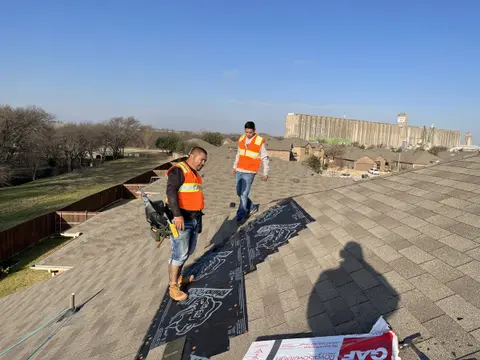
A professional inspection is the next step. A good one includes:
- A walk around the house documenting soft metal, siding, windows and screens.
- A walk of every slope, marking hits with chalk and counting them in a test square on each slope.
- Close-up photos of each type of damage with a scale reference.
- A look in the attic for daylight, wet decking or stains.
- An honest conclusion: no damage, minor damage, or damage that likely justifies a claim.
At Verde Roofing, Chris Grimes inspects the roof with you, documents the damage with photos, and explains repair versus replacement before any claim is filed. If there is nothing worth claiming, you hear that too. Our storm and hail damage service explains how that inspection works.
What happens if the inspection finds real hail damage?
If the damage is real and widespread, the next step is your decision, not the roofer's. You own the claim. You call your insurer to report it, and the insurer sends an adjuster. If you want, we meet the adjuster on site to show the damage we found and walk the roof together. Our insurance claim help page explains exactly what we do and what we can't do under Texas law.
Two Texas rules worth knowing now:
- Only a licensed public adjuster can represent you on a claim. Texas Insurance Code §4102.163 bars a contractor working on your property from acting as your public adjuster or advertising that it will. A roofer can inspect, document, meet the adjuster and write a repair estimate. Anyone who says they will take over your claim for you is promising something the law doesn't allow.
- You pay your deductible. Texas Business and Commerce Code §27.02 makes it an offense for a contractor to waive, absorb or rebate your deductible. More in why no roofer can legally waive your deductible.
If the damage is minor, a targeted roof repair may make more sense than a claim, especially if the repair costs less than your deductible.
Questions to ask whoever inspects your roof
Before you rely on anyone's opinion of your roof, ask:
- Can I see a photo of every mark you are calling hail damage, with a scale reference?
- How many hits did you count per test square on each slope?
- What did you rule out as blistering, wear or mechanical damage, and why?
- Is there collateral damage on the gutters, vents and A/C that matches the storm?
- If you found nothing, will you tell me that in writing?
A roofer who answers these clearly, and is willing to say "this is not hail," is one you can trust with the bigger job. You can read what homeowners say about how we inspect on our reviews page.
Get a free hail damage inspection
If hail hit your part of DFW and you see dented gutters, vents or A/C fins, have the roof looked at before small damage becomes a leak. Call or text Verde Roofing at (214) 687-1951, 24/7, or book a free roof inspection. Chris will walk the roof, photograph what he finds, and tell you plainly whether you have hail damage worth a claim.
Questions people ask next
Can hail damage a roof without me seeing anything from the ground?
Yes. Bruises and small cracks in shingles are rarely visible from the yard, especially on a two-story home or a steep roof. What you can see from the ground is collateral damage: dented gutters, downspouts, vents and A/C fins. If those are dented, a close inspection of the roof surface is worth it.
How big does hail have to be to damage shingles?
There is no single number, because age, shingle type, wind and how hard the stone is all matter. As a reference, the National Weather Service treats hail of 1 inch (quarter size) as severe. Older, sun-baked shingles can be damaged by smaller stones, and newer impact-resistant shingles often survive larger ones.
Is granule loss always hail damage?
No. Some granule loss along shingle edges and in gutters is normal weathering, and new roofs shed loose granules for a while. IBHS warns that seeing granules come off does not by itself mean hail. Hail granule loss sits in round, random spots with a bruise or crack under it.
Will my insurance pay for cosmetic hail damage?
It depends on your policy. The Texas Department of Insurance warns that a roof discount, especially on metal roofs, may come with an exclusion for cosmetic damage, meaning damage to looks but not function may not be paid. Read your declarations page and endorsements, or ask your agent, before you assume either way.
Should I get on my roof to check for hail damage myself?
We do not recommend it. Wet or granule-covered shingles are slippery, and a fall from a two-story roof is serious. Look from the ground, photograph what you see, and have a roofer with fall protection walk the roof. A good inspector will show you the photos of every mark they flag.
Sources
- IBHS: Is it hail damage? A guide to what is hail damage and what is not
- National Weather Service Boise: Hail size chart
- Triple-I: Facts + Statistics: Hail
- National Weather Service Birmingham: Severe thunderstorm criteria
- Texas Department of Insurance: After hail or windstorms
- Texas Department of Insurance: Metal roofs and home insurance, 4 key facts
Chris Grimes owns Verde Roofing in Plano, Texas, a locally owned residential and commercial roofer serving Dallas–Fort Worth. Verde is an NTRCA Accredited Member, an RCAT member and a Dallas Observer Best of Dallas Best Roofer winner (readers’ choice) in 2021, 2022 and 2023.
Keep reading
Related guides
 Hail & storm damageWhat to Do After a Hailstorm: The First 72 HoursAfter a hailstorm, wait until the storm has fully passed, then check for leaks and stop water from spreading. Photograph damage outside and inside before anything…Read the guide
 Hail & storm damageHow to Document Roof Storm Damage for Your Insurance ClaimTo prove roof storm damage, record the storm date, photograph hailstones and dented soft metal with a scale reference, capture wide and close-up photos of the…Read the guide Insurance claimsThe Insurance Adjuster's Roof Inspection: What to Expect and How to PrepareThe adjuster walks the roof, counts hail hits in test areas, checks soft metals, slopes and interior damage, measures the roof and writes an estimate. You…Read the guide