How to Choose a Roofing Contractor in Dallas–Fort Worth
 By Chris Grimes, owner of Verde RoofingPublished November 3, 2026 · 8 min read
In short
Pick a roofer who is local and easy to verify. Texas has no state roofing license, so check a physical DFW address, proof of liability and workers’ compensation coverage, city permits, voluntary credentials such as RCAT, and reviews. Get at least three written bids, as the Texas Department of Insurance advises, and walk away from anyone who offers to waive your deductible or asks for a large payment up front.
Key takeaways
- Texas does not license roofers at the state level, so the homeowner has to verify insurance, address, references and permits directly.
- The Texas Department of Insurance recommends at least three written bids on letterhead with a phone number and address.
- Waiving or absorbing your insurance deductible is illegal in Texas, and a contractor who offers it should be reported, not hired.
- Texas law bars a contractor from acting as a public adjuster on a property it works on, so a roofer documents damage but does not negotiate your claim.
- Most private Texas employers are not required to carry workers’ compensation, so ask for the certificate and verify it.
After a hailstorm in North Texas, your door gets knocked on, your mailbox fills with flyers and every yard sign on the street seems to belong to a different roofing company. Some of them will do excellent work. Some will be gone by next season.
Choosing well is mostly a matter of checking a few things that are easy to verify and refusing to be rushed. Here is how to do it in Dallas–Fort Worth, where Texas law gives you less help than you might expect.
Does Texas license roofing contractors?
No. The Roofing Contractors Association of Texas (RCAT) states plainly that the Texas Department of Licensing and Regulation does not currently license roofing contractors. There is no state exam, no state license number and no state board to complain to.
That means three things for you:
- A roofer who quotes a “Texas roofing license number” is either describing a voluntary credential or a city registration, or is misleading you.
- You have to do the verification yourself: insurance, address, permits, references.
- Voluntary credentials carry more weight here than in states with mandatory licenses.
RCAT runs a voluntary licensing program with roofing, business and safety exams, insurance or financial-responsibility documentation and yearly continuing education. RCAT also notes that its credential does not guarantee a contractor’s work, and that membership and licensing are separate. Our guide on Texas roofing licenses and what to check instead goes deeper.
What should I verify before I let a roofer on my roof?
Run through this checklist. A good contractor will make each item easy.
- A physical local address. Not just a phone number or a P.O. box. You want someone who will be here in five years when a flashing leak shows up.
- General liability insurance. Ask for a certificate of insurance, then call the agency listed on it to confirm the policy is active.
- Workers’ compensation, or a clear answer about it. The Texas Department of Insurance says private employers are not required to carry workers’ compensation in most cases. Ask whether the crew on your roof is covered, and verify a policy through the TXCOMP lookup TDI links to.
- Who pulls the permit. Most DFW cities require a permit for a full reroof. The City of Dallas, for example, requires a re-roof permit for replacing a large area or the whole roof, issued to registered contractors.
- Credentials you can look up. RCAT’s directory, trade association membership and manufacturer contractor programs each have their own public lookup. Check them yourself.
- Reviews on more than one platform, with recent dates and specifics.
- References in your area, ideally for work done a few years ago.
How do I compare roofing bids fairly?
The Texas Department of Insurance recommends getting at least three bids and comparing them with your insurance adjuster’s idea of what the repair should cost. Bids should be on company letterhead with a phone number and address.
Then line them up item by item:
| Line item | What a complete bid states |
|---|---|
| Shingles | Brand, product line and color |
| Tear-off | Number of layers removed, disposal included |
| Decking | Per-sheet price for replacement sheets |
| Underlayment | Synthetic or felt, product name |
| Ice and water barrier | Where it goes |
| Flashing and drip edge | New or reused, which locations |
| Ventilation | Intake and exhaust plan |
| Permit | Included, and who pulls it |
| Warranty | Manufacturer warranty name plus written workmanship warranty |
| Cleanup | Magnetic nail sweep, debris haul-off |
A low bid that leaves out three of these is not cheaper; it is incomplete. Our guide on how to read a roofing estimate explains each line, and the roof cost calculator gives you a rough range before the first visit.
What is a roofer’s role in my insurance claim?
Texas law draws clear lines here, and a trustworthy roofer stays inside them.
- The deductible is yours to pay. TDI says it is against the law for a contractor to offer to waive your deductible or work it into a bid. If a contractor offers, TDI advises finding someone else and reporting it to the Texas Attorney General at 800-621-0508. Our guide to the roof deductible under Texas law explains the rules.
- A contractor is not your adjuster. Texas Insurance Code §4102.163 bars a contractor from acting as a public adjuster on a property where it provides or may provide contracting services, or advertising that it will adjust claims. A roofer who promises to “take over” or “win” your claim is offering something the law does not let it offer.
- The claim stays yours. A good roofer inspects, documents the damage with photos, meets the adjuster on site to show what it found, writes a repair estimate and explains the process. You make the decisions with your insurer.
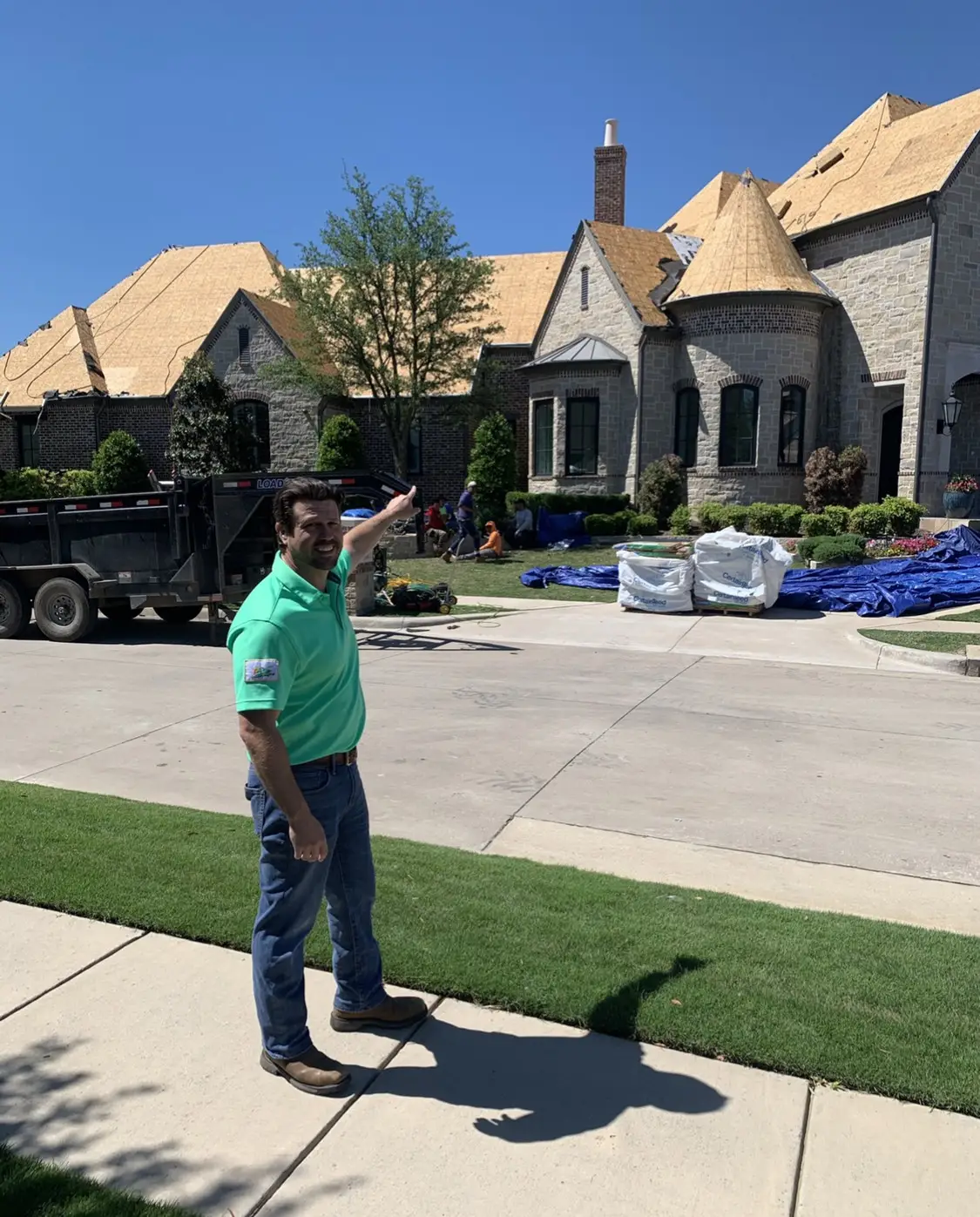
That is exactly how we work: Chris inspects the roof with you, documents damage with photos, meets the adjuster on site, and explains repair versus replacement before a claim is filed. More on our insurance claim help.
What are the red flags of a roofer to avoid?
TDI’s scam guidance and common sense point to the same warning signs:
- Offers to waive, cover or “work in” your deductible.
- Pressure to sign today, especially at the door.
- A large or full payment before work starts. TDI notes it is against the law for out-of-town contractors to require a down payment before starting work after a disaster.
- A contract with blank spaces, or one that says you agree to repairs “for the value of insurance proceeds.”
- A document called an “estimate” or “inspection form” that is really a contract.
- No local address, no certificate of insurance, no references.
- Claims of a state roofing license.
Our guides to storm chasers and roofing scams and roofing contract red flags cover these in detail.
What should the roofing contract include?
Once you have chosen, the contract is where good intentions become enforceable. TDI advises reading every document before you sign, never signing with blank spaces and making sure the contract lists the materials to be used. Beyond that, a solid roofing contract in Texas spells out:
- The full scope of work, matching the estimate line by line.
- The exact shingle line and color, and every accessory by brand.
- The price, the payment schedule and what triggers each payment.
- How supplements or added work (such as extra decking) are approved and priced.
- An approximate start window and what happens if weather delays it.
- The permit, and who pulls it.
- Cleanup and nail sweeping.
- The workmanship warranty terms and which manufacturer warranty will be registered.
If the job will be paid in whole or in part from insurance and costs $1,000 or more, Texas Business & Commerce Code §27.02 requires the contract to carry a notice, in at least 12-point bold type, that Texas law requires the insured to pay any deductible. The same section makes it a Class B misdemeanor to advertise or provide work that waives, absorbs or rebates the deductible. If that notice is missing from an insurance job contract, ask why.
How quickly do I need to decide after a storm?
Usually not as fast as a door-knocker suggests. If water is coming in, deal with that first: an emergency tarp protects the house, and the City of Dallas, for example, says no permit is needed for temporary measures such as tarps. Then take the time to verify contractors properly.
Your insurance policy sets the deadlines for reporting damage, and they vary, so read your own policy rather than relying on a salesperson’s version of it. A few days spent checking insurance certificates, references and bids rarely costs you anything; a rushed signature can.
What questions should I ask in the first meeting?
Use the first visit to see how the roofer works, not just what it charges. A few questions reveal a lot:
- Will you walk the roof with me, or show me photos of every slope?
- Who will be my point of contact during the job?
- Is the crew your own or subcontracted, and who supervises them on site?
- What happens if you find rotted decking?
- What does your workmanship warranty cover, and for how long, in writing?
- How do you protect landscaping, the driveway and the attic during tear-off?
We keep a full list of 25 questions to ask a roofer before you sign.
When I meet a homeowner after a storm, I would rather spend twenty extra minutes walking the roof and explaining what I see than rush a signature. Any roofer worth hiring should be glad you asked to see the damage yourself.
Why does hiring local matter so much in DFW?
Roofs fail at the details: a flashing joint, a pipe boot, a valley. Those problems often show up a year or two after the job, and the roofer’s workmanship warranty is only as good as the company’s presence here when you call.
A local contractor also knows the conditions: spring hail season, summer heat that ages shingles, expansive clay soil, tall two-story homes in Frisco and McKinney, older homes in Lakewood and the Park Cities, and HOA color rules in planned communities. Check the areas a roofer serves and whether its reviews come from your part of the Metroplex.
How do you check us out?
We expect you to verify us the same way. Verde Roofing is locally owned and based in Plano, serving eleven North Texas counties. We are an NTRCA Accredited Member and an RCAT member, and Dallas Observer readers voted us Best Roofer in the Best of Dallas readers’ choice awards in 2021, 2022 and 2023. Read what customers say on our reviews page, where we hold a 5.0 rating from 54 Google reviews, or learn more about Verde Roofing. Ask us for a certificate of insurance and references, and call them.
Ready to get a second opinion or a first estimate?
Chris will inspect your roof with you, photograph what he finds and give you a written estimate after a free inspection, with no pressure to sign. Call or text (214) 687-1951 (24/7) or book a free roof inspection.
Questions people ask next
Should I hire the roofer who knocked on my door after the storm?
Not without the same checks you would run on anyone else, and preferably not on the spot. Ask for a local address you can visit, proof of insurance, references in your area and a written estimate. The Texas Department of Insurance warns that out-of-town scam artists often arrive first after a disaster, so take a day to verify.
Is the cheapest roofing bid ever the right choice?
It can be, if it covers the same scope. Line up the bids by material, underlayment, flashing, ventilation, decking allowance, permits and cleanup. A low bid that omits items will grow later or cut corners. A bid far below the others, or far below your adjuster’s estimate, deserves a direct question about what is missing.
How many reviews should a good roofer have?
There is no magic number. Look for a steady history of recent reviews that mention specific people, communication and how problems were fixed, on more than one platform. A handful of detailed reviews from your area tells you more than hundreds of one-line ratings. Read the negative ones and the company’s replies.
Does a roofer need a permit in Dallas or Plano?
Most cities require a permit for a full reroof. The City of Dallas, for example, requires a re-roof permit when a large area or the entire roof is replaced, and registered contractors apply for it. Rules differ by city, so ask the roofer who pulls the permit and request the permit number before work starts.
What if my roofer goes out of business before the warranty ends?
The roofer’s workmanship warranty usually ends with the company, while a registered manufacturer warranty stays with the shingle maker under its own terms. That is one reason to favor a roofer with a long local track record and to keep the manufacturer warranty certificate, the contract and the final invoice in one folder.
Sources
- Texas Department of Insurance: How to avoid contracting scams
- Texas Business & Commerce Code §27.02: Deductible notice in contracts paid by insurance
- Roofing Contractors Association of Texas: Find a licensed Texas roofing company
- Texas Department of Insurance: Workers’ compensation coverage verification
- Texas Insurance Code §4102.163: Certain contractor business prohibited
- City of Dallas: Storm damage repair information
Chris Grimes owns Verde Roofing in Plano, Texas, a locally owned residential and commercial roofer serving Dallas–Fort Worth. Verde is an NTRCA Accredited Member, an RCAT member and a Dallas Observer Best of Dallas Best Roofer winner (readers’ choice) in 2021, 2022 and 2023.
Keep reading
Related guides
 Hiring a roofer25 Questions to Ask a Roofer Before You SignBefore hiring a roofer, ask where the company is based, how it is insured, who pulls the permit, who does the work, exactly which materials and…Read the guide Hiring a rooferDoes Texas License Roofers? What to Check InsteadNo. Texas has no statewide roofing contractor license, and the Texas Department of Licensing and Regulation does not license roofers. To verify a roofer, check city…Read the guide
 Hail & storm damageStorm Chasers: How to Spot a Roofing Scam After a Texas StormA storm chaser follows hail from city to city, knocks on doors, pushes you to sign that day, and is hard to find once the roof…Read the guide